
What this pilot measures
This pilot asks how much the execution harness can affect professional-work output when each environment requests the same model and reasoning effort. It compares three complete, configured systems: Rudder, Codex CLI, and Claude Code. Each system requestedgpt-5.6-sol with high reasoning effort. Its normal
orchestration, session, and tool boundaries remained part of the condition, so
this is not a comparison of identical stateless wrappers.
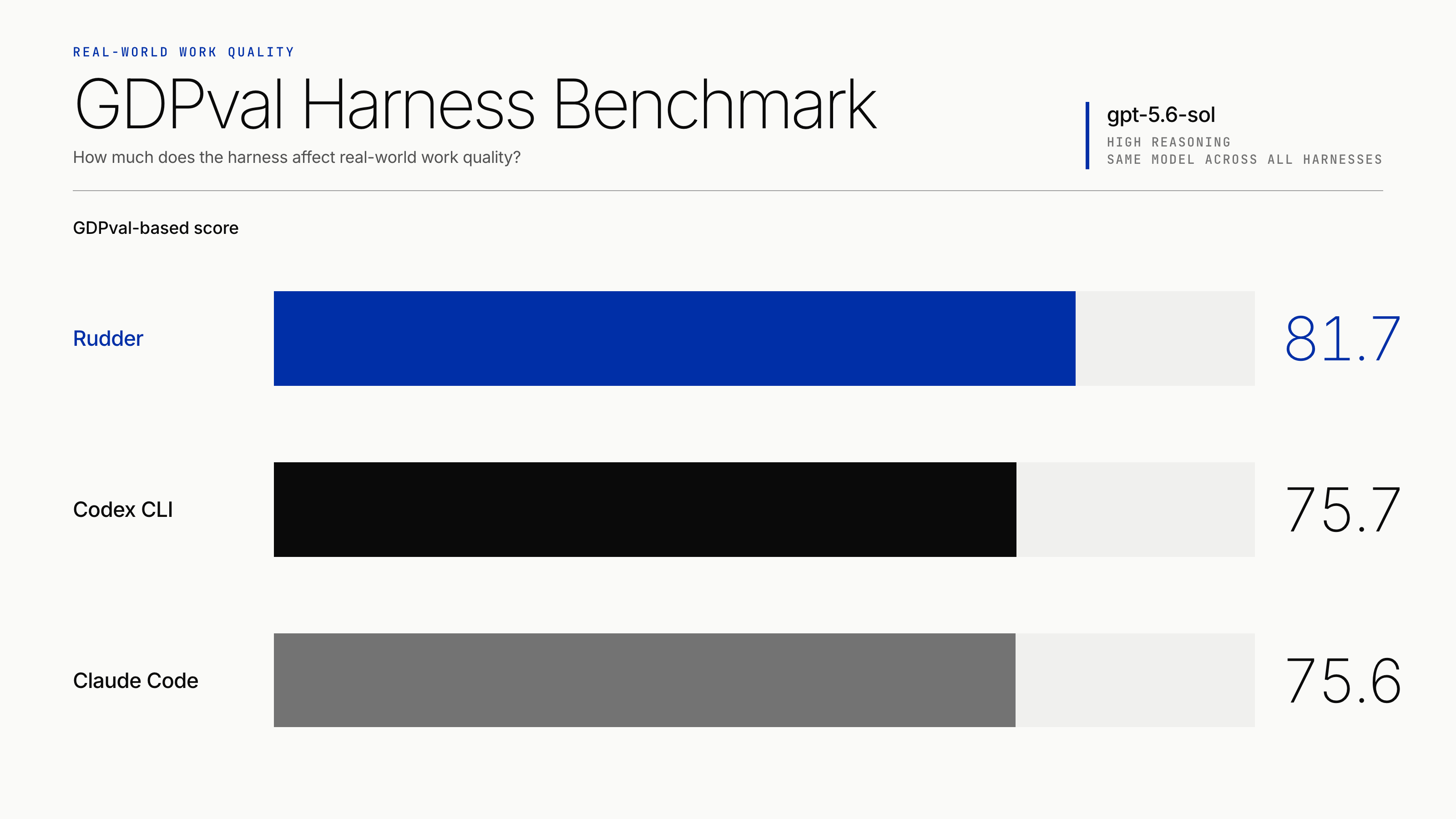
Results at a glance
| Harness | Local case-equal score | Valid artifacts | Candidate vs gold |
|---|---|---|---|
| Rudder | 81.7 | 10/10 | 9W / 0T / 1L |
| Codex CLI | 75.7 | 10/10 | 9W / 0T / 1L |
| Claude Code | 75.6 | 10/10 | 9W / 0T / 1L |
Frozen comparison
The pilot randomly sampled 10 tasks from the 220-task GDPval dataset, then froze the cohort before execution. It spans 10 occupations and requires 11 deliverables across XLSX, DOCX, PPTX, and PDF. Each task was run three times in total: once in Rudder, once in Codex CLI, and once in Claude Code. That produced 30 scored executions, with one execution for each harness-task combination. The task packages came from theopenai/gdpval dataset at revision
11e7900cdcac61bc4daf59e65feb238acda98fbf. The candidate could inspect the task
prompt and source files. Rubrics and gold deliverables stayed in a separate
scorer workspace.
Conditions compared
| Harness | Execution condition | Persistent state |
|---|---|---|
| Rudder | One organization and one default managed Agent were reused sequentially across all 10 cases, with Rudder’s managed instruction bundle and tools | Managed memory was active and read and written, but the reconstructed timeline contains one unexplained continuity reset |
| Codex CLI | Every case used a fresh workspace and session | No state was reused between cases |
| Claude Code | Every case used a fresh workspace and session routed through a compatibility adapter | No state was reused between cases |
Model identity evidence
All three conditions requestedgpt-5.6-sol with high reasoning effort. The
available evidence for the model that actually handled each request was not the
same in every harness.
| Harness | Verification available |
|---|---|
| Rudder | Run metadata matched the requested model for all 10 cases |
| Claude Code | Compatibility-adapter request logs observed gpt-5.6-sol, including requests translated from Claude aliases |
| Codex CLI | The request was configured for gpt-5.6-sol, but the event stream did not expose the actual model identity |
How scoring worked
A local LLM rubric judge scored every valid candidate separately without seeing the harness label. The judge inspected the source files, candidate deliverables, gold deliverables, and rubric items. It then recorded item-level evidence and a candidate-versus-gold judgment. Every result used the same judge configuration:gpt-5.6-sol with high
reasoning effort.
The primary measure gives every case equal weight even though GDPval rubrics
have different point scales:
Case-level results
The values below are awarded raw rubric points over the positive maximum. A negative result means penalty items outweighed positive points. The macro formula clamps that case to zero.| Case | Occupation | Claude Code | Codex CLI | Rudder | Vs gold |
|---|---|---|---|---|---|
| Audit risk metrics sample | Accountants and Auditors | 48/63 | 49/63 | 56/63 | all win |
| Enterprise UAT plan | Computer and Information Systems Managers | 83/101 | 74/101 | 87/101 | all win |
| Suspicious activity investigation | Compliance Officers | 62/69 | 58/69 | 62/69 | all win |
| Property superintendent performance plan | Property and Real Estate Managers | 66/85 | 62/85 | 67/85 | all win |
| Nature documentary script | Film and Video Editors | 50/51 | 51/51 | 51/51 | all win |
| BridgeMind POC monthly report | Project Management Specialists | 78/79 | 78/79 | 78/79 | all win |
| Inventory incident presentation | Shipping and Inventory Clerks | 74/81 | 72/81 | 76/81 | all win |
| Territory fit report | Sales Managers | 61/101 | 81/101 | 80/101 | all win |
| Tiny Rod finance report | Financial Managers | 62/76 | 62/76 | 62/76 | all loss |
| Duplex comparative market analysis | Real Estate Brokers | -70/50 | -35/50 | 10/50 | all win |
Evidence limits
The comparative market analysis case had unusually large penalty items and amplified the aggregate gap. Excluding that case, Rudder still led by about 4.4 to 4.6 percentage points. Keep these boundaries with any use of the result:- Each task ran three times in total, once in each harness. Because every harness-task combination still has only one execution, the pilot does not estimate run-to-run variance within a harness.
- The 10 tasks were randomly sampled from all 220 tasks, but the sample remains small and may not represent the full dataset.
- A local LLM judge produced the rubric scores, not GDPval’s blinded expert-human review process.
- All three harnesses finished 9W / 0T / 1L against gold. This is important counter-evidence to the score gap.
- The run history was recovered across setup and resume events, then audited from preserved execution and judgment records.
- Rudder memory was active, but continuity was incomplete and no Memory on/off ablation was run. The score difference cannot be attributed to Memory.
- Codex CLI model identity was verifiable only at request time.